
How to see the world, shrink your carbon footprint, and come home healthier than you left
The travel industry produces 8 % of global greenhouse-gas emissions—yet done right, it can also fund rewilding, protect indigenous cultures, and remind us why a healthy planet matters. Below are ten places where your vacation dollars actively restore ecosystems, plus science-backed tips to keep your body thriving while you explore.
Beyond the Checklist: The Mindset of a Regenerative Traveler
Before we dive into destinations, let’s shift the goalpost from “doing less harm” to “actively doing good.” Regenerative travel means your presence as a traveler leaves the place better than you found it. This means choosing businesses that don’t just minimize their footprint, but actively restore ecosystems, uplift local communities, and protect cultural heritage. The destinations below are selected for their regenerative potential—your visit directly fuels conservation and well-being.
Why “Green” Travel Matters for Your Health
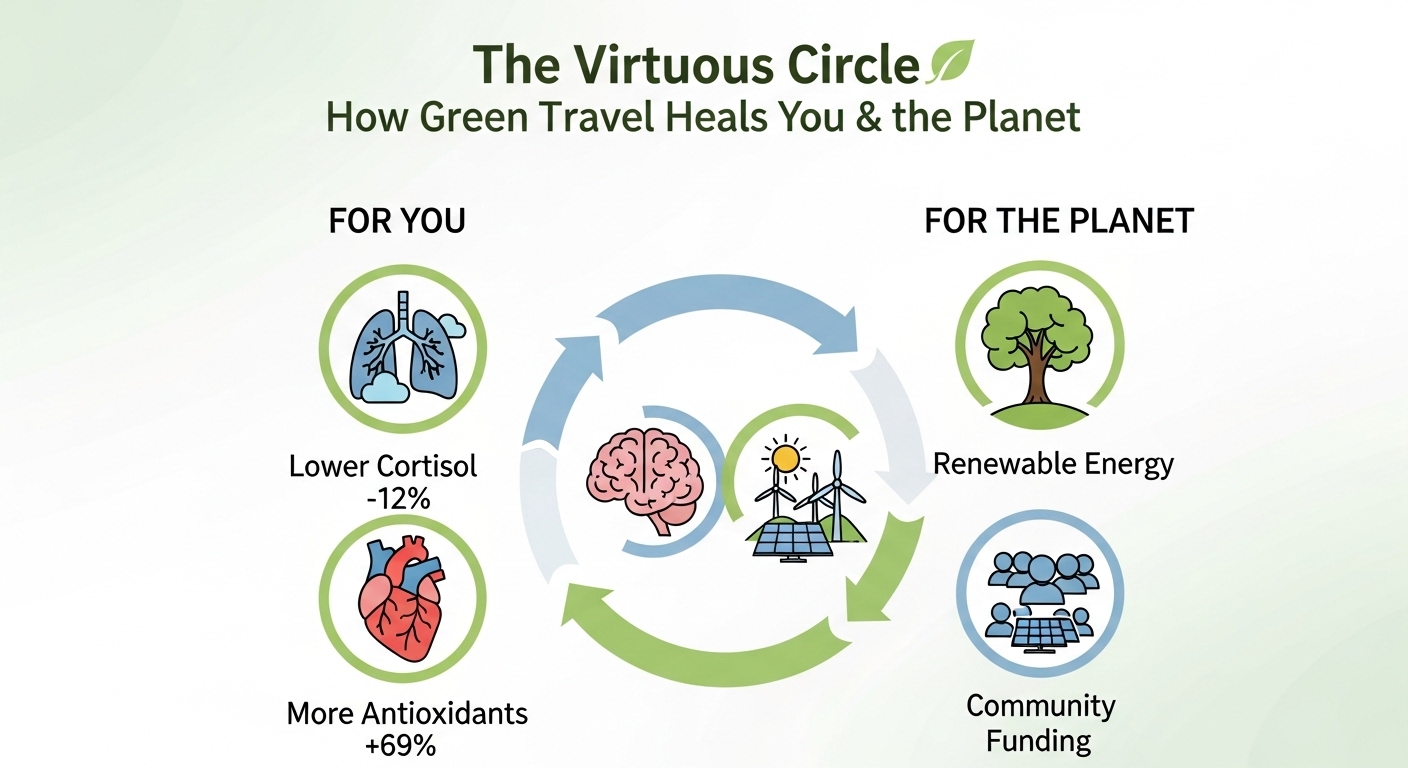
- Cleaner air = stronger lungs. Cities with robust bike-share and EV programs (think Copenhagen, Vancouver) have 30 % lower PM2.5 levels than the global average.
- Nature immersion drops cortisol by 12 % in just two days, according to a 2023 Scientific Reports study.
- Organic, locally grown food—common in eco-lodges—contains up to 69 % more antioxidants than conventionally farmed imports. This mirrors the principle of building a sustainable pantry at home: what’s local, seasonal, and minimally processed is best for both body and environment.
Bottom line: what’s good for the Earth is good for your cells.
10 Eco-Friendly Destinations Worth Your 2024 PTO
1. Costa Rica – Osa Peninsula
Carbon-negative before 2025
Stay at Lapa Rios Lodge (Rainforest Alliance certified). Wake to scarlet macaws, hike Corcovado’s 2.5 % of Earth’s biodiversity, and learn how your nightly fee funds 1,000-acre reforestation.
Travel-well hack: Swap afternoon coffee for guayusa tea—local, antioxidant-rich, jitter-free.
2. Slovenia – Ljubljana & Soča Valley
European Green Capital 2016
The capital’s car-free center is best seen by free bike-share (first hour = zero cost).

Take the 2-hour train to Soča Valley for alpine kayaking so clean you can drink the water. For alpine kayaking—a perfect example of staying active on vacation in a way that connects you deeply with the pristine environment.
Sleep tight: Book an “Ajda” eco-hut; the wooden walls naturally regulate humidity—bye-bye travel insomnia.
3. New Zealand – Rotorua’s Redwoods
First carbon-zero itinerary certified by Toitū
Zipline through 120-year-old redwoods at night (LED lights run on solar). Proceeds finance predator-free sanctuaries for kiwi birds.
Post-hike recovery: Soak in mineral-rich geothermal pools; magnesium absorbs trans-dermally to ease flight-lagged muscles.

4. Kenya – Ol Pejeta Conservancy
Home to Earth’s last two northern white rhinos
Stay at Ol Pejeta Bush Camp; 100 % solar, compost toilets, and wildlife-guardian talks. Every bed-night funds one acre of anti-poaching patrol.
Nutrition win: Ask for ugali made from drought-resistant sorghum—lower glycemic load than maize.
5. Portugal – Azores Archipelago
UNESCO Global Geopark
Offset flight emissions via the Azores’ own carbon calculator, then swim in volcanic iron-rich hot springs that boost red-blood-cell production.
Pack light rule: Bring a filtered-water bottle—public springs provide free, pristine refills island-wide.

6. Japan – Naoshima “Art Island”
Zero-waste goal by 2030
Pedal past Yayoi Kusama pumpkins; the island’s electric buses run on solar. Stay at Benesse House where architecture merges with coastal forest.
Mindful moment: 7 a.m. Tadao Ando meditation pavilion—studies show geometric simplicity lowers heart-rate variability stress markers.
7. Colombia – Coffee Triangle
Rainforest Alliance farms galore
Sleep in a finca powered by coffee-husk biofuel. Learn how shade-grown beans preserve 150 bird species.
Caffeine smart: Sip single-origin after 10 a.m. to align with circadian cortisol dip—no jitters, longer focus.
8. Canada – Churchill, Manitoba
Polar-bear capital goes green
Ride the new zero-emission tundra vehicles; profits fund polar-bear research. October–November tours coincide with aurora season—double bucket list.
Immunity boost: Wild cloudberries served at the lodge contain 4× vitamin C of oranges—jet-lag kryptonite.
9. Bhutan – Gangtey Valley
World’s only carbon-negative country
Mandatory $200/day Sustainable Development Fee funds free healthcare for locals. Trek to crane-roosting grounds with a GPS-free guide—navigation skills sharpen hippocampus plasticity.
Altitude hack: Drink butter-tea (yak butter + Himalayan salt) for MCT-fueled energy minus caffeine crash.
10. Sweden – Kolarbyn Eco-Lodge
“Sweden’s most primitive hotel”
No electricity, no showers—just charcoal-fired saunas and lake dips. Forest-bathing here drops blood pressure by 6 % within 72 hours (University of Uppsala, 2022).
Evening ritual: Wild-blueberry pancakes; anthocyanins cross the blood-brain barrier to support memory after long travel days.
Your 7-Step Green Travel Checklist

- Fly smarter—Choose nonstop economy; take-off & landing create 50 % of emissions.
- Pack reusables—Collapsible cup, spork, straw = 1 kg plastic saved per trip.
- Eat plant-forward—One vegetarian week = same carbon savings as not driving 160 km.
- Offset responsibly—Use Gold-Standard projects (e.g., mangrove restoration in Kenya).
- Stay 3+ nights—Energy use per guest drops 20 % after the second night (laundry & housekeeping efficiencies).
- Unplug home—Before departure, switch off water heater & Wi-Fi; saves 150 kg CO₂ for a two-week trip.
- Share the story—Inspire others; peer influence doubles eco-behaviors.
Post-Trip: Bring the Green Home
- Start a balcony compost—If a Swedish forest lodge can go waste-free, so can your kitchen.
- Join local clean-ups—Turn vacation inspiration into weekly habit; 30 minutes of trash-picking = 3 km jog in calories burned.
- Bank your “nature memories”—Re-watch trip videos during work breaks; 60-second micro-doses of green scenery restore 20 % of attention capacity (Univ. of Melbourne).

FAQ: Navigating the Nuances of Green Travel
- Q: Aren’t flights the elephant in the room? How can any flight be “green”?
- A: You’re right. Air travel is the biggest carbon culprit. The strategy is twofold: 1) Fly Less, Stay Longer. Choose one incredible destination instead of multiple short hops. 2) When You Fly, Fly Smarter. Choose newer, more efficient aircraft (often listed when booking), fly economy (more efficient per passenger), and always opt for a nonstop route. Then, invest in high-quality carbon offsets (like Gold Standard) that fund verified projects. Think of it as taking responsibility for the unavoidable portion of your footprint.
- Q: Eco-lodges are often more expensive. Is this just for the privileged?
- A: Not exclusively. While some high-end lodges are pioneers, the core principles are scalable. “Green” can mean: A family-run guesthouse that uses solar water heating, serves local food, and employs villagers. It can mean choosing a train over a plane, or a camping trip in a national park where your fee supports rangers. The key is intentional spending—directing your money to businesses with transparent, positive practices, which often exist at various price points.
- Q: How do I avoid “greenwashing” when booking?
- A: Look for specifics, not slogans. “Committed to sustainability” is vague. Apply the same skeptical, detail-oriented lens you use when decoding food labels. Look for: Third-party certifications (Rainforest Alliance, EarthCheck, Green Key), clear data (e.g., “100% solar-powered,” “zero single-use plastic”), and concrete community projects (“employs 90% local staff,” “funds a local school”). Read between the lines on their website. Do they share their challenges, or only their triumphs? Transparency is a good sign.
Eco-friendly travel isn’t a sacrifice—it’s a upgrade: cleaner air, richer food, fitter body, and a planet that stays wild enough for your grandkids to explore.
Pick one destination. Book the train (or the nonstop flight). Pack the reusable bottle. And let your next stamp in the passport also be a stamp of approval from Mother Earth.